Summary by Heather Woodley
Moon Walk
The June Probus meeting featured Ron Macnaughton speaking about the preparation for the amazing feat of Neil Armstrong and Buzz Aldrin landing on the moon. Armstrong and Aldrin were heroes indeed as audiences watched spellbound to see the July 20 1969 television coverage of these two men walking on the surface of the moon. What viewers did not realize is the fact that there were 400,000 individuals who had worked to make this extraordinary accomplishment possible. Because the earth’s gravity is six times greater than that of the moon there could be no test flying of the module. Therefore simulators were made with dials and controls identical to those of the moon-bound command module. Models of the moon were made with craters the size of large buildings. Since the computers of the 1960’s could not generate images, being multiple times less powerful that the I phones of today, eyepieces were made to show the astronauts where they would land in the simulated moon landing. In the actual moon landing Armstrong and Aldrin were faced with an uneven, unknown landing surface, and an inexact landing location. They thought they had landed on the west crater but had not. Consequently they had to hover above the moon’s surface, eventually moving to the right after almost running out of fuel. After landing it was necessary to reset their navigation system in case of an emergency take-off. Neil Armstrong’s words have echoed through history. This truly was “One small step for man, one giant leap for mankind.”
Ron Macnaughton can’t take you to the moon, but he can take you to the actual devices used to train Neil Armstrong and other astronauts to land on a different world they did not understand well in a spaceship which had never flown before. Incredible ingenuity was needed.
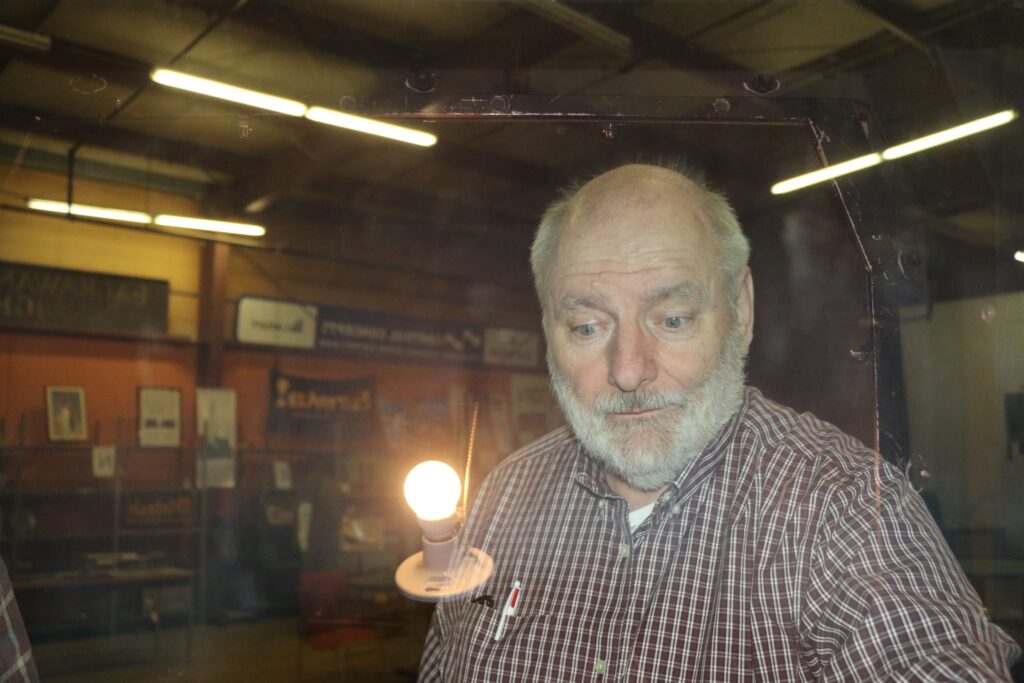
The astronauts could see images floating in air such as this image of Ron using the same system.